


About the course
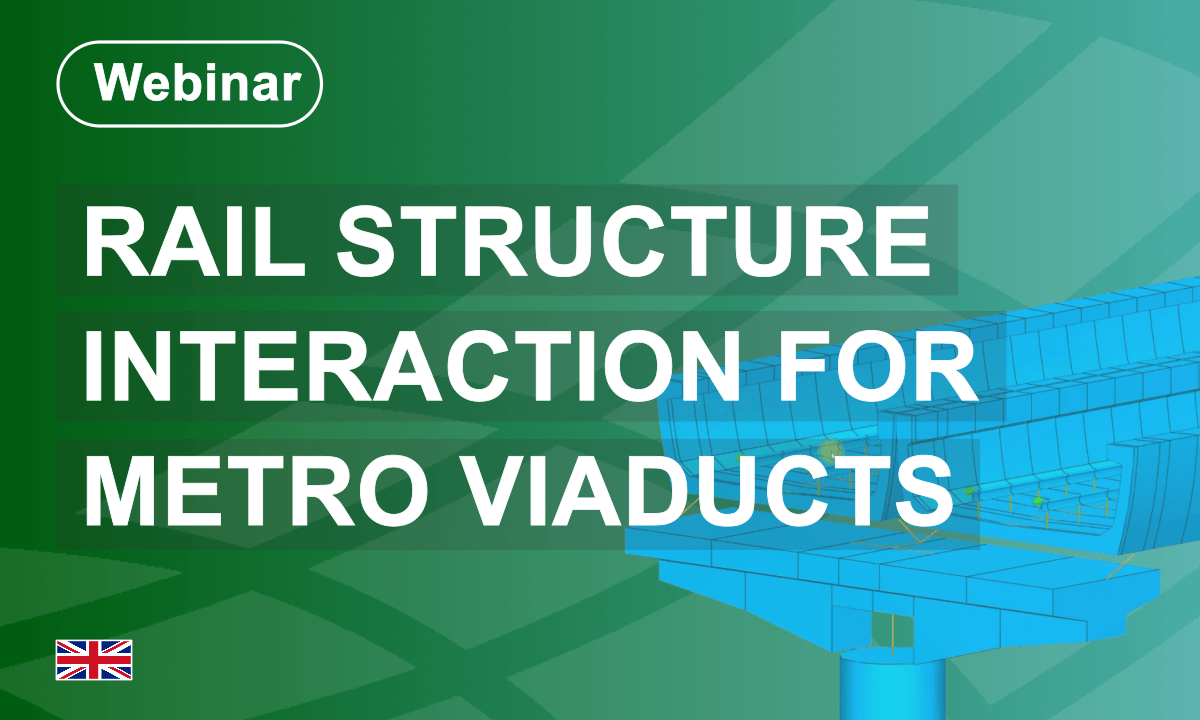
Explore Rail–Structure Interaction (RSI) for metro viaducts, from fundamental behaviour and design requirements to practical nonlinear analysis and automation. Learn how temperature, braking, traction, vertical train loads, track behaviour, support stiffness, and bridge configuration influence rail stresses and displacements. Practical case studies cover U-girder viaducts, station structures, mixed superstructures, special spans, and complex multi-track configurations. The webinar demonstrates simplified and staged nonlinear RSI analysis using bilinear track springs, together with validation against a UIC example. An Excel-based approach automates bridge geometry, loading and analysis input and generates reports containing rail stresses, displacements and support reactions.
What you'll learn
- Explain how temperature, braking, traction and vertical train loads influence Rail–Structure Interaction
- Model rails, bridge structures, supports and nonlinear track behaviour using bilinear springs
- Perform simplified and staged nonlinear RSI analyses for complex metro viaduct configurations
- Evaluate rail stresses, displacements and support reactions against relevant RSI design requirements
- Automate RSI model input, analysis and Excel reporting for different bridge geometries and alignments
Course content
Instructors
Access Learning Content
Smart Rail Structure Interaction (RSI) for Metro Viaducts
Explore Rail–Structure Interaction (RSI) for metro viaducts, from fundamental behaviour and design requirements to practical nonlinear analysis and automation. Learn how temperature, braking, traction, vertical train loads, track behaviour, support stiffness, and bridge configuration influence rail stresses and displacements. Practical case studies cover U-girder viaducts, station structures, mixed superstructures, special spans, and complex multi-track configurations. The webinar demonstrates simplified and staged nonlinear RSI analysis using bilinear track springs, together with validation against a UIC example. An Excel-based approach automates bridge geometry, loading and analysis input and generates reports containing rail stresses, displacements and support reactions.
- Non-editing teacher: Nivedita Kumar
- Enrolled students: 4
Self enrolment as 'Student'
- Language: English
- Level: Expert
- Duration : 1 Hour
- Platform: AutoCAD
- Application: Structural Desktop
- Version: 2026
This course includes
Resources